North
Carolina's Wild Horses
Beaufort's Wild
Horses of the Rachel Carson Reserve
(part of the N.C. Coastal Reserve and National Estuarine Research
Reserve)
Like
the wild Shackleford mustangs, Beaufort's wild horses can only be
reached by boat, where they have free run of the main area of Rachel
Carson Reserve, made up of Town Marsh, Carrot Island, Bird Shoal and
Horse Island. Another part of the reserve called Middle Marshes is
not accessible to the horses. The reserve acreage is not suitable
for human habitation and has extremely little fresh water, which is
mostly ground water the horses find by digging.
Unlike North Carolina's
other three groups of wild horses, the Beaufort horses' lineage is
not isolated to the bloodlines of the Colonial Spanish Mustangs, though
they carry that historic heritage. These horses are descended from
stock kept on these islands in the 1940s by a Beaufort physician.
The original herd consisted of "Banker Ponies", like those
on Ocracoke, along with some domestic stock - mainly Quarter Horses.
Though they are today considered "feral" horses, many of
them plainly exhibit the characteristics of the wild Outer Banks horses
descended from the spanish mustang stock that first arrived on these
barrier islands as far back as the early 1500's. In fact, some of
these horses carry the primitive markings of the most ancient of wild
horse breeds and types.
These primitive
markings consist of a "dorsal stripe" or spinal stripe, that runs
along the spine from ears to tail, and sometimes leg bars as well.
The fighting stallion in this
photo taken on Town Marsh plainly shows the dark dorsal stripe,
as does the horse in the photo immediately to the right.
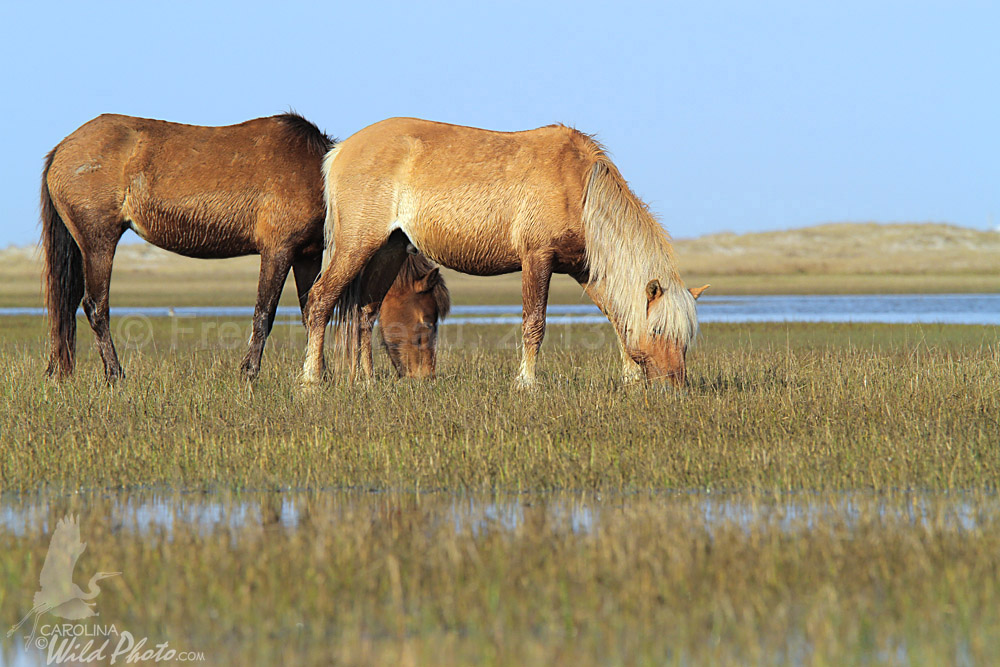
The islands of
the reserve surround a large estuary, or tidal marsh, where the horses
spend much of their time feeding on the grass that grows there in
profusion. This tidal marsh is also a great location for many bird
species. As was noted, reaching the reserve's sand dune islands requires
a boat. Once on the islands, you can hike about to find the horses.
However, to boat out into the great expanse of the shallow tidal marsh
requires a small, very shallow draft boat, such as a kayak. At high
tide, it is possible to kayak across the tidal flats to reach areas
like Bird Shoal for close viewing of the birds that frequent this
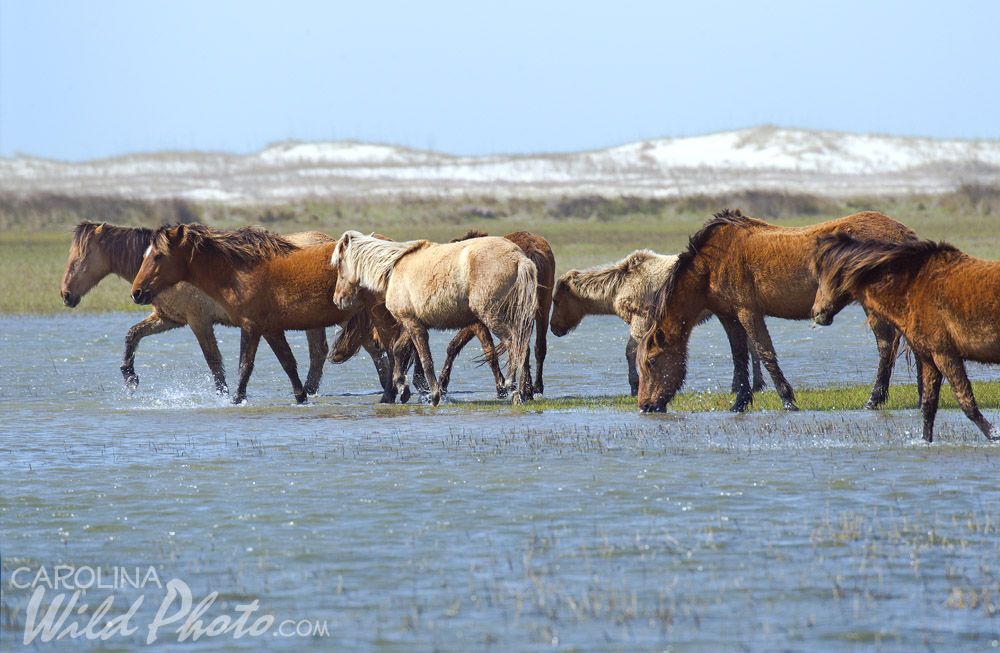
area. With the right tide depth, it's possible to paddle among the
wild horses while they feed in the marsh, which is an exceptional
experience.
Such a paddling
adventure can be tricky because of the changing tide, winds and currents.
Inexperienced paddlers might consider the services of a knowledgeable
guide to insure the best experience. However, walking the area to
find the horses is a much simpler affair.
The western end
of the reserve, Town Marsh, has two hiking trail loops. Off-trail
hiking is an option, as the island is not very large. Although it
is virtually impossible to get lost on foot, it's easy to find yourself
wandering about with no idea where you are going or how to get back
without some knowledge of the area. First time visitors with little
hiking experience should learn what they can about the lay of the
land before striking out off the trails in order to make the most
of their time. Once again, a knowledgeable guide can make the experience
more rewarding.
The abundance
of birds and wildlife, along with the wild horses, makes the reserve
a popular spot for birdwatching and wildlife photography, not to mention
those who come to see the horses.
|
|